
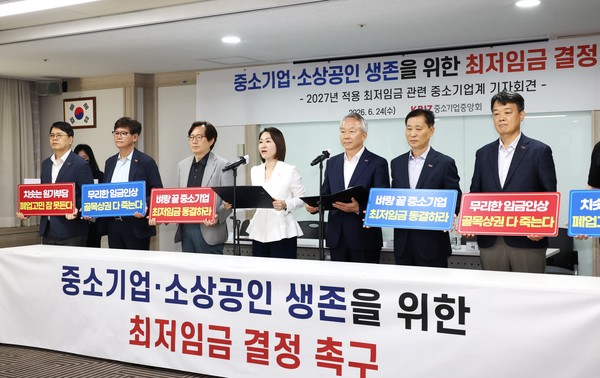

With labor costs, input costs, and rent burdens piling up in neighborhood economies, both the livelihoods of low-wage workers and the sustainability of businesses must be considered together.
As deliberations on next year’s minimum wage approach, appeals from the self-employed and small business owners about their burdens are growing louder. More than half say their operating conditions worsened compared to last year, and many report having no capacity to hire additional staff. The claim that minimum wage hikes translate into cost pressures for micro-enterprises is gaining traction again. Yet explaining the plight of the self-employed by pointing to minimum wage alone overlooks the complex realities on the ground.
According to a business environment survey of the self-employed commissioned by the Korea Economic Association, 57 percent of respondents said their operations deteriorated compared to last year, while only 8.4 percent reported improvement. Seventy-one percent earn less than three million won per month, and 34 percent say their monthly income falls short of the minimum wage equivalent for a 40-hour workweek. These figures signal that the recovery of local commercial districts remains elusive.
Capacity to hire is also weakening. Fifty-nine percent of survey participants said they currently lack the ability to recruit staff, and 38 percent are preparing to raise prices. When both labor and input costs rise simultaneously, self-employed operators tend to either delay hiring or pass on expenses through price hikes. Consumers then feel the squeeze of higher prices, and workers may face job cuts. This is why the minimum wage debate extends beyond wages to encompass employment and inflation issues.
This year’s minimum wage stands at 10,320 won per hour, which translates to 2,156,880 won for a 209-hour month. The Minimum Wage Commission raised the rate by 290 won, or 2.9 percent, from 10,030 won in 2025. Although modest compared to past double-digit increases, the cumulative cost burden weighs more heavily on self-employed operators.
Raising the minimum wage goes beyond just hourly pay. Employers must consider weekly holiday pay, social insurance contributions, retirement allowances, and various other allowances. When wages for new hires increase, existing skilled workers may also demand pay adjustments. Even a seemingly small hourly increase can ripple through total labor costs. This is why small businesses feel the impact of minimum wage hikes more acutely than the headline rate suggests.
The demand for freezing next year’s wage reflects these concerns. In the survey, 44.6 percent of self-employed respondents called for a wage freeze, and another 20.6 percent sought an increase below 3 percent. That amounts to about two-thirds favoring no change or minimal raises—not simply out of protest, but as a defensive response to sluggish revenues alongside rising costs.
However, freezing the minimum wage alone will not resolve the crisis facing the self-employed. High interest rates, rent, raw material costs, delivery platform fees, franchise expenses, weak domestic demand, and excessive competition all contribute to their worsening conditions. In a weakened market where consumer spending is down, a stagnant minimum wage may still fail to revive sales. Minimizing wage increases can relieve some pressure, but it falls short of a comprehensive solution.
The issue of workers’ livelihoods must also be addressed. While minimum wage hikes represent a cost to business owners, for low-wage workers they set a floor for basic living expenses—housing, food, transportation, and communication. If the minimum wage stays flat amid rising prices, real wages decline. Reduced spending power among low-wage workers can in turn weigh on the sales of neighborhood businesses.
Therefore, the minimum wage discussion should not pit the self-employed against workers. Both micro-enterprises and minimum wage earners are vulnerable. Overemphasizing one side erases the reality of the other. Ignoring employers’ capacity with steep increases risks shrinking employment; freezing wages without regard for living costs undermines workers’ livelihoods.
The question of sector-specific rates must also be considered in the same context. Industry groups argue it is unreasonable to apply uniform minimum wages to sectors such as hospitality, small-scale manufacturing, and service industries, where labor costs constitute a large share of expenses. Differences in profitability and labor productivity mean that equal increases impose unequal burdens. Factoring in these on-the-ground differences merits examination.
Yet sectoral differentiation carries significant downsides. If certain industries receive lower minimum wages, workers in those fields become legally bound to a lower wage floor. Hospitality and care services often employ higher proportions of women, young people, seniors, migrant workers, and non-regular staff. Lower wage standards risk entrenching low-wage structures among these vulnerable groups. Even if sectoral differentiation gains traction, it must be weighed against the danger of widening labor market disparities.
High rates of minimum wage underpayment are likewise multi-faceted. They may signal that many businesses cannot afford to pay the legal minimum, but they also indicate failures in enforcement and leave vulnerable workers unprotected. In industries like hospitality, where underpayment rates are high, easing business burdens must go hand in hand with stronger labor inspections. Lowering wage floors alone will not restore confidence in the system.
Government action should extend beyond tweaking the increase rate. Reducing social insurance costs for micro-enterprises and providing temporary support to sectors hit hardest by labor cost shocks are necessary. Delivery platform fees, mandatory franchise item costs, rent, card fees, and loan interest burdens also warrant attention. For subcontractors and suppliers, mechanisms to adjust purchase prices should be in place. If employers alone bear minimum wage burdens, pressure to cut employment will only intensify.
Income support measures such as the earned income tax credit also need enhancement. Raising the minimum wage is not the sole means to protect low-wage workers. A combination of tax credits, direct cash support, housing subsidies, and social insurance assistance can partially offset the strain of wage increases while safeguarding real incomes. The minimum wage serves as the labor market’s bottom line; welfare and taxation should complement that floor. Viewing these policies in isolation guarantees repeated conflicts each year.
Extending the minimum wage decision cycle merits discussion, too. Annual reviews fuel labor-management conflicts and make it difficult for businesses to plan next year’s labor costs. Adopting a two- to three-year framework could improve predictability. However, in times of volatile prices or economic downturns, failing to adjust wages in a timely manner could harm real incomes. Any longer cycle must include trigger mechanisms to respond to sudden inflation spikes or recessions.
The hardships revealed by this survey cannot be taken lightly. Worsening operating conditions, low monthly incomes, lack of hiring capacity, and preparations for price hikes all point to mounting pressures on neighborhood economies. But offering a wage freeze as the sole remedy falls short. Though self-employed owners and low-wage workers may appear to stand on opposite sides, both are squeezed by weak domestic demand and rising costs. Policies must be designed to support both simultaneously, not to divide them.
Deliberations on the minimum wage have long served as an arena for annual labor-management confrontations. This year’s debate must broaden its perspective: reflect the capacity of micro-enterprises while upholding the minimum wage’s purpose of ensuring low-wage workers’ livelihoods. Avoid sharp increases, but recognize that a freeze alone is insufficient. What is needed is not a contest over a low increase, but a policy package that simultaneously protects vulnerable businesses and vulnerable workers.