
Judicial Investigator System as Fears of a “Second Prosecutors’ Office” Surface
The government has unveiled legislation to establish the Major Crimes Investigation Agency and the Prosecution Office on the premise of abolishing the Prosecutors’ Office, but resistance has emerged within the ruling party. The core point of contention is the organizational structure of the Major Crimes Investigation Agency and the status of judicial investigators within it. Observers note that the direction of prosecutorial reform, aimed at a complete separation of investigation and prosecution, has once again been put to the test. The fact that public criticism arose from within the ruling party immediately after the bill’s release underscores this assessment.
The controversy originates from the organizational design proposed by the government. The plan divides the agency into judicial investigators and professional investigators. Judicial investigators would be limited to individuals with attorney qualifications and would assume command over key investigative departments. Critics argue that this structure is not fundamentally different from the existing prosecutors–investigators framework within the current Prosecutors’ Office.
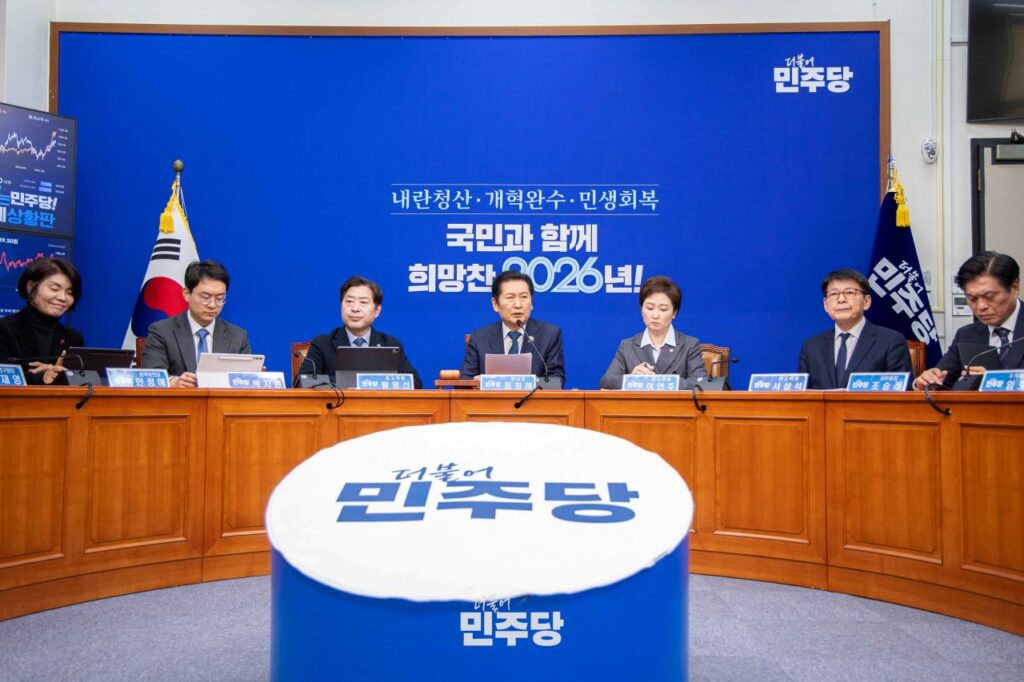
The Democratic Party leadership has formally acknowledged internal disagreements. Newly appointed floor leader Han Byung-do stated that opinions diverge between the government and party members, including over whether to retain supplementary investigation powers. While the government prefers to address the issue during revisions to the Criminal Procedure Act, a significant number of lawmakers within the party insist that supplementary investigation powers should be abolished from the outset. Underlying this stance is concern that the substantive reduction of prosecutorial power could be undermined.
Internal criticism has expanded to the organizational framework itself. Floor spokesperson Kim Hyun-jung warned that a system centered on judicial investigators could ultimately lead to a concentration of authority similar to that of the existing Prosecutors’ Office. Lawmaker Noh Jong-myeon likewise cautioned that the agency could come to be seen as a new Prosecutors’ Office or a new Supreme Prosecutors’ Office special investigation unit. The concern is that the reform’s intent to disperse investigative power may remain intact in form but not in substance.
From a policy perspective, the debate strikes at the core principles of prosecutorial reform. The separation of investigation and prosecution has been designed as an institutional safeguard against the concentration of power. However, if a figure with quasi-judicial authority comes to lead the investigative body, the possibility of power being re-centralized reemerges. The controversy highlights how seemingly minor choices at the design stage can shape the entire power structure.
Past cases show that when institutional reforms changed names without altering underlying power structures, public trust in reform quickly eroded. Many analysts argue that repeated failures of prosecutorial reform stem from shortcomings in the substantive design of power dispersion. This historical experience also informs Justice Innovation Party leader Cho Kuk’s warning about the potential formation of a cartel between the Major Crimes Investigation Agency and the Prosecution Office.
Looking ahead, the outcome will depend on how internal party deliberations unfold. While the Democratic Party plans to gather opinions through a policy caucus meeting, the leadership’s request to refrain from public criticism suggests that internal tensions remain significant. Whether the Major Crimes Investigation Agency becomes a symbol of reform or falls prey to criticism as a second Prosecutors’ Office will ultimately be determined during the legislative process. The episode once again underscores that prosecutorial reform is completed not by slogans, but by structure.