
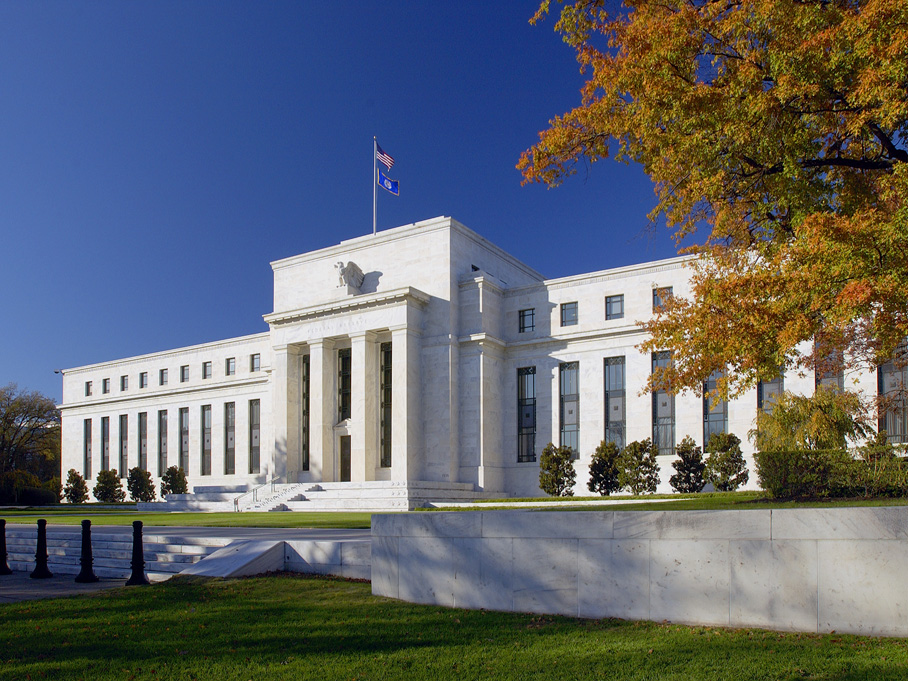
The Federal Reserve has raised interest rates again, ending a three-year pause in rate increases and reinforcing a broader shift toward higher borrowing costs across the U.S. economy.
At its Sept. 15-16 meeting, the Federal Open Market Committee raised the target range for the federal funds rate by 25 basis points to 3.75%-4.00%. The decision was unanimous. The Fed said economic activity continued to expand at a solid pace, domestic spending remained resilient and inflation was still elevated.
The move was notable not only because it was the first rate increase since 2023.
It also raised a larger question for households, businesses and investors: Is the U.S. moving into a period in which interest rates remain structurally higher than they were during the 2010s?
Why did the Fed raise rates now?
The Fed’s immediate explanation was inflation.
The central bank said inflation remained elevated and that the rate increase was intended to support a more timely return to its 2% inflation goal. At the same time, the Fed described economic activity as solid, with resilient spending, strong productivity growth and robust capital investment.
That combination matters.
Central banks are more likely to tolerate lower rates when inflation is subdued and demand is weak. The current U.S. economy presents the opposite problem: inflation remains above target while consumer spending and business investment continue to support growth.
The Fed’s September projections reinforce that tension.
FOMC participants projected median PCE inflation of 3.7% for 2026 and core PCE inflation of 3.4%, both still well above the central bank’s 2% objective. Their median projection for the federal funds rate was 4.1% at the end of 2026.
That suggests the Fed does not expect the inflation problem to disappear quickly.
Higher rates are already moving through the economy
The Fed controls a short-term policy rate, but its decisions influence a much wider range of borrowing costs.
After the September increase, the effective federal funds rate moved from 3.63% to 3.88%. The bank prime loan rate rose from 6.75% to 7.00%, while the primary credit rate increased to 4.00%.
Longer-term rates were already elevated before the Fed acted.
The 10-year Treasury yield reached 5.01% on Sept. 16 before easing to 4.94% the following day, according to Federal Reserve data. The 30-year Treasury yield remained above 5.2%.
Those longer-term yields matter because they help shape the cost of mortgages, corporate borrowing and other financing.
Mortgage rates have responded accordingly.
The average 30-year fixed mortgage rate climbed to 6.95% last week, its highest level in more than a year and a half.
For households, the result is straightforward: buying a home, financing a car or carrying debt remains expensive.
For companies, the cost of funding investment is also higher.
This is not just a Fed story
One of the most important points is that the Federal Reserve is not the only force pushing interest rates higher.
The U.S. economy itself is generating unusually strong demand for capital.
Major technology companies are investing heavily in artificial intelligence infrastructure, including data centers, semiconductors, power capacity and related equipment. At the same time, the federal government continues to issue large amounts of debt to finance budget deficits.
Those borrowers are effectively competing for capital.
When governments and corporations seek more financing at the same time, investors may demand higher yields.
That helps explain why longer-term Treasury rates have remained elevated even when investors have periodically expected the Fed to ease monetary policy.
The 10-year Treasury yield moved above 5% in September, a level with broad implications for mortgage rates, corporate debt and equity valuations.
The implication is important.
Even if the Fed eventually cuts its short-term policy rate, long-term borrowing costs may not return automatically to the very low levels seen in the previous decade.
AI investment is becoming a monetary-policy factor
The current cycle has another unusual feature: artificial intelligence investment is now large enough to influence broader macroeconomic conditions.
Technology companies are spending heavily on data centers, chips, networking equipment, power infrastructure and construction.
That investment supports economic growth, but it also creates pressure on capital markets, labor, electricity supply and industrial equipment.
AP reported that economists increasingly view the AI buildout as one of the factors supporting stronger growth and higher longer-term interest rates.
This creates an unusual policy challenge for the Fed.
Higher productivity and investment are generally positive for the economy.
But when investment demand becomes strong enough to collide with supply constraints, it can also contribute to inflationary pressure.
The result is that a technology boom can simultaneously support economic growth and make monetary easing more difficult.
The U.S. economy looks stronger than many expected
The Fed’s rate increase also reflects the resilience of the broader economy.
Consumer spending has remained stronger than expected, while business investment has continued to expand.
Some economists now estimate that the U.S. economy could grow at an annualized rate of around 3% in the third quarter, helped by household spending and technology-related investment.
This matters because high interest rates usually work by slowing demand.
If consumers and companies continue spending despite expensive credit, monetary policy may need to remain restrictive for longer.
That is one reason the current rate cycle looks different from the post-2008 period.
During much of the 2010s, economic growth was relatively weak, inflation was subdued and investment demand was modest.
Today, demand for capital is much stronger.
Why the 2010s may not be coming back
For more than a decade after the global financial crisis, U.S. households and businesses became accustomed to unusually low borrowing costs.
Mortgage rates frequently stayed well below historical averages, corporate financing was cheap and low bond yields supported high valuations across many asset classes.
That environment was shaped by several factors: weak demand after the financial crisis, low inflation, slower investment and abundant global savings.
The current economy looks different.
Inflation is higher. Government borrowing is larger. Technology investment is accelerating. Energy and geopolitical risks remain significant.
Federal Reserve Chair Kevin Warsh described this broader shift at the central bank’s annual Jackson Hole conference, noting that capital is now moving aggressively into AI-related infrastructure rather than remaining on the sidelines.
That does not mean interest rates can never fall again.
It does suggest that the extremely low-rate environment of the 2010s should not automatically be treated as the normal baseline.
What the Fed’s projections say
The Fed’s own projections point toward a gradual, not immediate, decline in rates.
The median FOMC projection places the federal funds rate at 4.1% at the end of 2026 and 4.1% again in 2027, before falling to 3.9% in 2028 and 3.6% in 2029. The longer-run median estimate is 3.2%.
Those numbers are projections, not commitments.
Economic conditions can change quickly, particularly if inflation falls faster than expected or growth weakens.
But the trajectory is notable.
Even the Fed’s longer-run estimate is well above the near-zero policy rates that became familiar after the 2008 financial crisis and during the pandemic.
That is one of the clearest signals that policymakers themselves may see a different interest-rate environment ahead.
Businesses face a new cost of capital
For companies, persistently higher rates change investment calculations.
Projects that looked attractive when financing was cheap may no longer generate sufficient returns.
Real estate developers face higher construction and refinancing costs.
Startups may find equity and debt capital more expensive.
Highly leveraged companies may face greater pressure as older low-rate debt matures and needs to be refinanced.
Even large corporations are affected.
Higher Treasury yields raise the benchmark against which many corporate bonds are priced, increasing borrowing costs across the market.
This can influence everything from mergers and acquisitions to factory construction and share buybacks.
The pressure is especially visible in housing
Housing provides the most immediate example of how higher rates affect the real economy.
Mortgage rates near 7% have sharply increased monthly payments for buyers compared with the ultra-low-rate period earlier in the decade.
At the same time, many existing homeowners hold mortgages issued at much lower rates and are reluctant to sell.
This creates a lock-in effect that limits housing supply while higher borrowing costs weaken demand.
The result is an unusual market in which transactions can remain weak without producing a rapid decline in prices.
Higher-for-longer rates therefore affect housing through both demand and supply.
What this means for Korean companies in the U.S.
The shift toward higher U.S. interest rates is directly relevant to Korean companies expanding in the United States.
Automakers, battery producers, semiconductor companies and other manufacturers have announced major U.S. investments in recent years.
Those projects often require large amounts of capital for factories, equipment, energy infrastructure and working capital.
A structurally higher-rate environment increases financing costs and raises the return required to justify new investment.
It can also affect customers.
Higher auto-loan rates may influence vehicle demand, while expensive mortgages can weaken housing-related consumption.
For Korean companies, the U.S. investment equation therefore increasingly requires more than estimating labor, logistics and tax incentives.
The cost and availability of capital have become strategic variables as well.
A higher-rate economy creates winners and losers
Higher interest rates do not affect every part of the economy in the same way.
Banks and savers can benefit from higher yields on deposits and fixed-income assets.
Cash-rich companies may earn more on liquid assets.
But borrowers face higher costs.
Households with variable-rate debt, homebuyers, property developers and leveraged companies are generally more exposed.
Financial markets also need to adjust.
When Treasury yields rise, investors can earn higher returns from relatively low-risk government securities. That can reduce the relative attractiveness of stocks and other risk assets unless expected returns also increase.
This is one reason interest rates affect asset valuations far beyond the bond market.
The next question is not simply when rates fall
Much of the market debate in recent years has focused on when the Federal Reserve would begin cutting rates.
The September increase changes that conversation.
The more important question may now be where interest rates eventually settle.
The Fed could still cut rates if inflation declines or the economy weakens.
But the combination of persistent inflation, stronger investment demand, large government borrowing and geopolitical uncertainty means that the equilibrium level of U.S. interest rates may be higher than it was during the previous decade.
The latest rate hike does not prove that the low-rate era is permanently over.
It does, however, provide another sign that businesses and households should not assume a rapid return to the financing conditions that defined the 2010s.
For the U.S. economy, the adjustment may be less about a temporary rate cycle and more about learning to operate in a world where money itself is structurally more expensive.