
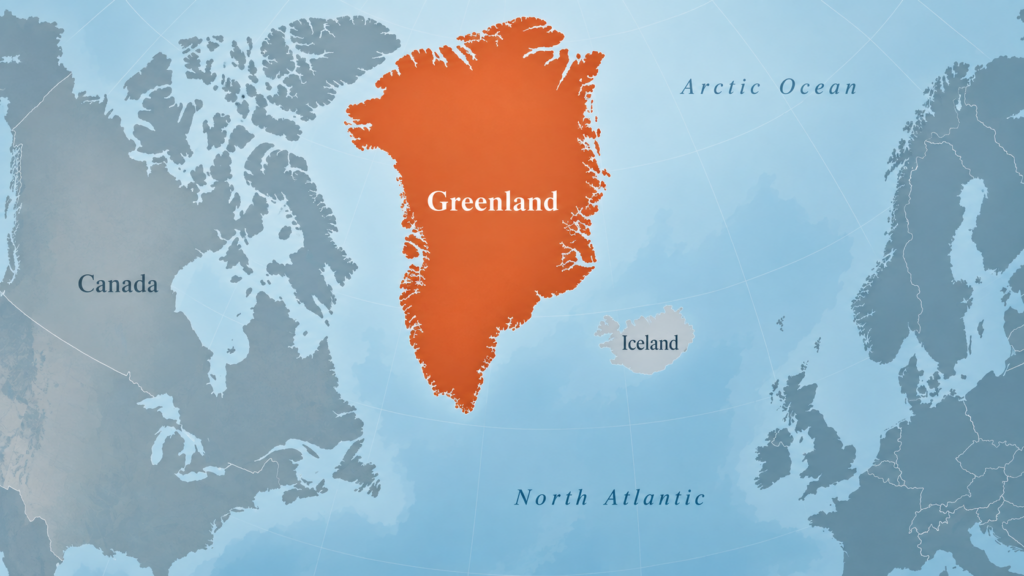
Greenland has returned to the center of U.S. attention after the United States, Denmark and Greenland announced plans for a new agreement to strengthen security in the Arctic and North Atlantic.
The three governments said Sept. 18 that they expect to sign the agreement during the United Nations General Assembly in New York. The pact would then require the necessary parliamentary procedures before taking effect. Denmark and Greenland have emphasized that the agreement recognizes the sovereignty and territorial integrity of the Kingdom of Denmark and Greenlanders’ right to self-determination.
The announcement helped push Greenland back into U.S. search interest. But the renewed attention goes well beyond territorial politics.
Greenland sits at the intersection of military security, critical minerals, Arctic shipping and a broader competition among the United States, Europe, Russia and China over the economic and strategic future of the far north.
What changed in the U.S.–Greenland relationship?
President Donald Trump said the emerging agreement would give the United States broad and lasting authority to address security concerns in Greenland.
Denmark and Greenland have described the arrangement more narrowly.
Their joint position is that the agreement will strengthen collective security in the Arctic and North Atlantic while preserving sovereignty, territorial integrity and Greenland’s right to self-determination. The full terms have not yet been made public.
That distinction matters.
The agreement is not an announced transfer of Greenland to the United States. Instead, it appears to expand security cooperation within a framework in which Greenland remains a self-governing territory within the Kingdom of Denmark.
The United States already has substantial defense rights in Greenland under a 1951 agreement with Denmark.
Its most visible presence today is Pituffik Space Base in northwestern Greenland, the U.S. military’s northernmost installation. The base supports missile warning, missile defense and space surveillance missions.
The proposed agreement would build on that longstanding relationship as Arctic security becomes a larger priority for NATO members.
Why Greenland matters to U.S. security
Geography is the first reason.
Greenland lies between North America and Europe and occupies a critical position along approaches connecting the Arctic Ocean with the North Atlantic.
It also sits near the Greenland-Iceland-United Kingdom, or GIUK, Gap, a strategic maritime corridor that has long been important for monitoring naval movements between the Arctic and Atlantic.
For the United States, that makes Greenland valuable for missile detection, space surveillance and North Atlantic defense.
The importance of the region has increased as Russia has expanded military infrastructure across its Arctic territory and NATO members have increased their own Arctic security activities. European leaders meeting in Finland last week described the Arctic as a growing arena of geopolitical competition.
Denmark, Greenland and other European governments have also expanded exercises and investments in the region.
Earlier this month, Denmark said 10 allied countries would participate in Arctic Shield exercises involving operations on land, at sea and in the air around Greenland.
The result is that Greenland is no longer viewed only as a remote Arctic territory.
It is becoming an increasingly important part of the security architecture linking North America and Europe.
Critical minerals add an economic dimension
Security is only part of Greenland’s growing importance.
The island contains deposits of minerals used in technologies ranging from electric vehicles and batteries to renewable energy systems and advanced electronics.
Rare earth elements have attracted particular attention as the United States and Europe try to reduce their dependence on concentrated global supply chains.
That does not mean Greenland is about to become a major mining center overnight.
Developing mineral projects in the Arctic is expensive. Harsh weather, limited infrastructure, long distances and environmental requirements can make projects substantially more difficult than similar developments elsewhere.
Greenland also maintains its own political and regulatory authority over resource development.
Those constraints help explain why the island’s resource potential has received attention for years without producing mining activity on the scale that headline resource estimates might suggest.
But geopolitical conditions are changing the economics.
Governments and companies increasingly value supply-chain security alongside production cost. A mineral deposit that once appeared marginal can become more strategically attractive if it reduces dependence on politically sensitive suppliers.
The emerging U.S. security arrangement could therefore have consequences beyond defense.
The Wall Street Journal reported that the greater diplomatic clarity is already raising expectations among some companies seeking investment opportunities in Greenland’s mining, infrastructure and energy sectors.
Europe is investing too
The United States is not the only major economic actor increasing its engagement with Greenland.
The European Union has been strengthening its relationship with the territory and earlier this month deepened its partnership with Greenland and Denmark.
European Commission President Ursula von der Leyen visited Nuuk in September as part of that effort, while European institutions have been discussing additional investment in infrastructure, connectivity and economic development.
The competition is therefore more complicated than a simple U.S.-versus-Europe rivalry.
Denmark and other European governments remain close U.S. allies within NATO. At the same time, Europe wants to maintain strong economic and political ties with Greenland as the island’s strategic importance grows.
Greenland itself also has interests that do not always align perfectly with either Washington or Brussels.
Its government has repeatedly emphasized Greenlandic self-determination and the need for economic development to benefit the local population.
That makes investment, infrastructure and resource policy central to the island’s long-term political choices.
Climate change is altering the Arctic economy
Another force is changing the strategic calculation: the Arctic itself is becoming more accessible.
Declining sea ice has increased interest in northern shipping routes that could eventually shorten some maritime journeys between Asia, Europe and North America.
The commercial significance of those routes remains uncertain.
Arctic shipping faces extreme weather, difficult navigation, limited rescue infrastructure and seasonal constraints. It is not yet a straightforward alternative to established global shipping corridors.
Still, the direction of change matters.
European leaders meeting in Rovaniemi, Finland, last week specifically linked melting Arctic ice with increasing competition over shipping routes, natural resources and security.
That creates a feedback loop.
As the Arctic becomes more economically accessible, governments have greater incentives to invest in military infrastructure, ports, communications and resource development. Those investments, in turn, make the region more commercially relevant.
Greenland sits close to the center of that transformation.
Greenland could become an infrastructure story
The most immediate economic opportunities may not be mining.
Large-scale development in Greenland would require roads, ports, airports, telecommunications, electricity, housing and logistics.
Security expansion would create its own infrastructure requirements.
This is why the economic discussion surrounding Greenland increasingly includes tourism, construction, logistics, consulting and communications alongside critical minerals.
For an island with a small population and limited infrastructure, even relatively modest outside investment can have a large local economic impact.
But development will also raise questions over ownership, environmental standards, labor and how much of the economic benefit remains in Greenland.
Those questions will become more important if U.S. and European capital flows accelerate.
What Greenland means for Korean industries
The Arctic debate also has implications for South Korea.
Korea is one of the world’s largest shipbuilding nations and has significant industrial positions in batteries, advanced materials, automobiles and logistics — sectors that could be affected by changes in Arctic trade and mineral supply chains.
For Korean shipbuilders, greater Arctic commercial activity could increase long-term interest in ice-capable vessels, LNG carriers, specialized offshore ships and other equipment designed for extreme conditions.
For battery and advanced-material companies, the more immediate issue is critical minerals.
Any successful development of Greenland’s mineral resources could contribute to diversification of supply chains that currently depend heavily on a limited number of producing countries.
Korean companies should nevertheless distinguish strategic potential from commercial reality.
Greenland’s mineral resources may be significant, but difficult geology, infrastructure costs, permitting requirements and Arctic operating conditions mean that many projects could take years to reach commercial production.
The same caution applies to shipping.
A more accessible Arctic does not automatically mean that northern routes will quickly replace existing routes through the Suez Canal or other established corridors.
The Arctic is becoming an economic-security issue
The latest Greenland agreement illustrates a broader change in how major economies view the Arctic.
Military security, energy security, mineral supply chains, infrastructure and trade routes are increasingly difficult to separate.
That is why a security agreement involving Greenland can quickly become an investment story, a mining story and a shipping story at the same time.
For Washington, Greenland offers a strategically located platform for Arctic and North Atlantic defense.
For Denmark and Europe, it is both part of the regional security architecture and an increasingly important economic partner.
For Greenland, greater international interest may create new opportunities for investment and development while also increasing the importance of maintaining political and economic control over how that development proceeds.
What happens next
The proposed security agreement is expected to be signed during the U.N. General Assembly.
Even after signing, it will not immediately settle every question surrounding the U.S. role in Greenland.
The agreement will still face parliamentary procedures, and many details — including the scale of any expanded U.S. military presence and the precise rules surrounding sensitive foreign investments — have not yet been released.
That makes the next phase important.
The most consequential question may not be whether the United States gains formal ownership of Greenland. Denmark and Greenland say sovereignty will remain intact.
The larger issue is how much military, economic and investment activity will flow into the island as the Arctic becomes more important to global security and supply chains.
Greenland’s return to U.S. search interest is therefore not simply another episode in a territorial dispute.
It reflects a much larger shift: the Arctic is moving from the geographic periphery toward the center of global economic and security strategy.