
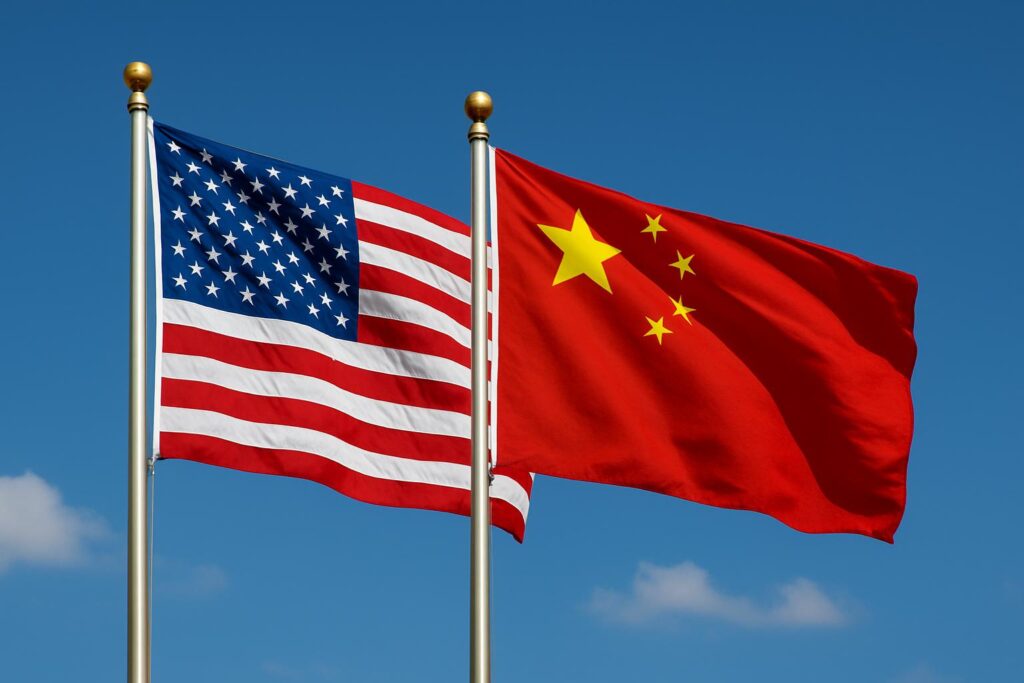
- Washington and Beijing reopen high-level economic talks ahead of a Trump-Xi summit
- Tariffs remain central, but AI, rare earths and supply-chain security are reshaping the agenda
- The negotiations show how trade policy is increasingly merging with technology and national security
The United States and China have opened a new round of high-level economic talks in New York, with tariffs still at the center of negotiations but artificial intelligence, critical minerals and supply-chain security emerging as equally important parts of the bilateral economic relationship.
U.S. Treasury Secretary Scott Bessent and Chinese Vice Premier He Lifeng began consultations on Sept. 20, joined by other senior economic officials, ahead of a planned meeting between President Donald Trump and Chinese President Xi Jinping in Washington later this week. Reuters reported that the talks are intended to lay the groundwork for potential agreements covering tariffs, AI and critical minerals.
China’s Ministry of Commerce separately confirmed that He would lead a delegation to the United States from Sept. 19 to 23 for discussions on economic and trade issues of mutual concern. Chinese state media reported that the two delegations formally began consultations in New York on Sunday morning.
The meeting is important because the U.S.-China trade relationship is no longer defined by tariffs alone. Technology controls, semiconductor access, rare-earth supplies, AI safety and industrial investment are increasingly being negotiated alongside conventional trade issues.
Tariffs remain the most immediate issue
The most concrete area of negotiation remains tariffs.
The two countries have been discussing a reciprocal tariff-reduction framework covering at least $30 billion worth of products from each side, with negotiations focused primarily on goods viewed as less sensitive from a national-security perspective.
China’s Ministry of Commerce said in May that both sides had agreed in principle to discuss tariff reductions on products of equivalent scale through a bilateral trade mechanism. The ministry later said that U.S. and Chinese officials remained in close contact over the details of the arrangement, although the specific products had not yet been finalized as of mid-September.
The proposal represents a narrower approach than the broad tariff confrontation that defined earlier phases of the trade war.
Rather than attempting an immediate removal of most trade barriers, the two governments appear to be exploring selective reductions where both sides can identify commercially useful products without giving up controls they consider strategically important.
That distinction is important because the bilateral trade relationship has become more segmented.
Agricultural goods, consumer products and selected industrial items may be candidates for tariff relief, while semiconductors, AI hardware, drones and other strategic technologies remain subject to much tighter controls.
Technology policy is now part of trade policy
The biggest change in the relationship is the growing overlap between trade and technology.
The United States has increasingly treated advanced semiconductors and other technology products as national-security assets rather than ordinary traded goods.
Earlier this year, Washington imposed a 25% tariff on certain covered semiconductor imports while creating exemptions for chips used in U.S. data centers, research, startups and domestic manufacturing projects. The administration described the measure as part of a strategy to strengthen the American semiconductor supply chain.
Similar measures now extend into other technology sectors.
In August, the White House announced tariffs and minimum-price measures involving polysilicon and related products, while also imposing steep tariffs on certain unmanned aircraft systems and components.
These policies illustrate how the definition of trade protection has changed.
Tariffs are increasingly being used not only to protect domestic producers from foreign competition but also to reshape supply chains in industries considered strategically important.
For China, that means market access to the United States can depend on technology policy, national-security rules and industrial strategy at the same time.
AI has moved onto the negotiating table
Artificial intelligence is now becoming a formal part of U.S.-China economic dialogue.
Before the current round of talks, U.S. Treasury Secretary Scott Bessent said Washington was open to discussing shared AI risks with China, including questions surrounding open- and closed-weight models.
Reuters had previously reported that the two governments were preparing official bilateral discussions focused specifically on AI safety, the first such talks under the current Trump administration.
The significance goes beyond technology regulation.
The AI competition between the United States and China depends heavily on access to advanced semiconductors, data centers, electricity, cloud infrastructure and specialized manufacturing equipment.
Those inputs are also trade goods.
As a result, AI governance and trade policy increasingly overlap.
The United States may seek cooperation with China on managing certain AI risks while simultaneously restricting access to advanced chips or other technologies that Washington considers strategically sensitive.
China, meanwhile, has argued that technology restrictions should not be used to limit its economic development and has opposed what it describes as politicization of trade issues.
This creates an unusual negotiating environment in which the two countries may cooperate on some aspects of AI safety while competing intensely over the industrial resources needed to develop the technology.
Critical minerals remain a major source of leverage
Critical minerals are another central issue because they sit at the intersection of manufacturing, energy and national security.
Rare earth elements are essential for products ranging from electric vehicles and wind turbines to advanced electronics and defense systems.
China plays a dominant role in the processing and refining of many of these materials, giving Beijing significant influence over global supply chains.
The United States has been trying to reduce that dependence by supporting domestic production and building alternative supply relationships with allies.
That makes rare-earth exports an important negotiating tool.
Reuters reported that critical mineral flows are among the issues being discussed in the current New York talks, while earlier negotiations also addressed China’s rare-earth export controls.
For companies, this means tariff negotiations can no longer be analyzed separately from supply-chain access.
A lower tariff on one product may provide limited benefit if a manufacturer still lacks reliable access to critical raw materials or components.
Agriculture remains one of the more traditional trade issues
Not every part of the negotiations is focused on strategic technology.
Agricultural trade remains important because U.S. farmers depend heavily on export markets, while China remains a major importer of agricultural products.
Previous U.S.-China talks addressed market-access issues involving beef, poultry, dairy products and aquatic products, as well as broader agricultural purchases.
Agriculture is often viewed as one of the areas where practical agreements may be easier to reach because the economic benefits are relatively clear.
American producers gain access to a large consumer market, while China gains access to food and agricultural supplies.
Even here, however, trade policy can become entangled with broader political and regulatory issues, including food safety rules, inspection requirements and retaliatory tariffs.
The relationship is shifting from broad trade war to managed competition
The current negotiations suggest that the U.S.-China economic relationship is gradually becoming more selective.
Earlier phases of the trade conflict were characterized by broad tariff increases across large categories of imports.
The emerging model is more differentiated.
Some products may receive tariff relief, while technologies considered strategically sensitive could face additional restrictions.
That means the two economies are not necessarily moving toward either full decoupling or a return to the pre-trade-war model of deep integration.
Instead, the relationship increasingly resembles managed competition.
Trade continues where both sides see economic benefits, while governments intervene more aggressively in sectors linked to national security, industrial policy or technological leadership.
For companies operating across the two markets, that creates a more complicated environment than a simple tariff schedule.
Businesses increasingly need to understand product classification, export controls, local-content requirements, investment restrictions and supply-chain rules alongside conventional customs duties.
Mexico and other third countries are being drawn into the competition
The economic effects of U.S.-China competition are also spreading beyond the two countries.
The United States has been pressing Mexico to strengthen rules governing the origin of AI hardware and other technology products as Washington seeks to prevent Chinese-made components from entering the U.S. market indirectly through North American supply chains.
The Wall Street Journal reported that U.S. officials are considering stricter regional-content requirements for products such as AI servers, chips and electronics as part of broader trade discussions with Mexico.
This illustrates how U.S.-China trade policy increasingly affects global manufacturing networks.
A company may assemble a product in Mexico, source components from Asia and sell the finished system in the United States.
Determining whether that product qualifies for favorable tariff treatment therefore depends not only on where final assembly takes place but also on where its critical components originate.
The result is a growing emphasis on supply-chain traceability.
Korean companies are directly exposed to the new trade architecture
The evolution of U.S.-China trade policy has particularly important implications for South Korean companies because Korea is deeply integrated into both economies.
Korean semiconductor companies sell products into China while also investing heavily in U.S. manufacturing.
Battery producers rely on global mineral supply chains but must also meet increasingly complex U.S. requirements related to sourcing and local production.
Automakers operate manufacturing networks that span Korea, North America and multiple Asian suppliers.
For these companies, a limited reduction in U.S.-China tariffs could improve trade conditions in selected sectors, but broader technology and supply-chain restrictions may still increase compliance costs.
Semiconductor companies need to track which chips qualify for U.S. tariff exemptions and which technologies are subject to export controls.
Battery manufacturers must monitor mineral sourcing rules as Washington seeks to reduce reliance on Chinese processing.
Equipment and materials companies may face pressure to disclose the origin of components used in products assembled in third countries.
The emerging system therefore rewards companies that can diversify production and sourcing rather than relying on a single supply chain.
Korea could also benefit from selective supply-chain diversification
The restructuring of U.S.-China trade is not entirely negative for Korean industry.
As American companies seek alternatives to Chinese suppliers in strategically important sectors, Korean firms may gain opportunities in semiconductors, batteries, advanced materials, automotive components and industrial equipment.
Korea already has significant positions in many of these industries and has expanded manufacturing investment in the United States.
But the opportunity comes with costs.
Producing in multiple countries can reduce geopolitical exposure but usually increases capital spending, operational complexity and inventory requirements.
Companies may need separate production lines or supplier networks for the U.S., Chinese and other markets.
That can weaken some of the efficiency advantages that global supply chains were originally designed to create.
The economic question is therefore not simply whether Korean companies gain market share.
It is whether the additional revenue is sufficient to offset the higher cost of operating inside a more fragmented global trading system.
A tariff deal would not end strategic competition
Even if Washington and Beijing agree on targeted tariff reductions this week, the underlying economic rivalry is unlikely to disappear.
The United States continues to view semiconductor manufacturing, AI infrastructure and critical mineral supply as strategic priorities.
China continues to pursue its own industrial policies in many of the same sectors.
Both governments are also trying to reduce vulnerabilities in supply chains they consider essential to economic and national security.
This means a trade agreement could stabilize parts of the commercial relationship without reversing the broader trend toward strategic competition.
The distinction matters for investors and companies.
A reduction in selected tariffs could improve near-term trade volumes and reduce costs for some businesses, while longer-term restrictions on technology and supply chains continue to expand.
The two developments can occur simultaneously.
What to watch in the Trump-Xi meeting
The immediate question is how much of the current negotiating agenda can be converted into concrete agreements when Trump and Xi meet.
Tariff reductions on selected nonsensitive goods appear to be among the most commercially tangible possibilities, while the future of the broader trade truce will also be important.
AI dialogue could produce mechanisms for communication or information sharing without resolving the underlying technological competition.
Critical minerals may prove more difficult because they directly affect supply-chain security and provide both sides with strategic leverage.
The details will matter more than broad statements about cooperation.
Companies will need to know which products receive tariff relief, how long any agreement lasts, whether export controls change and what commitments apply to critical minerals.
Until those details are available, the most important conclusion from the current talks is structural.
U.S.-China trade negotiations are no longer primarily negotiations about trade.
They have become negotiations about the architecture of technology, industrial capacity and global supply chains.