
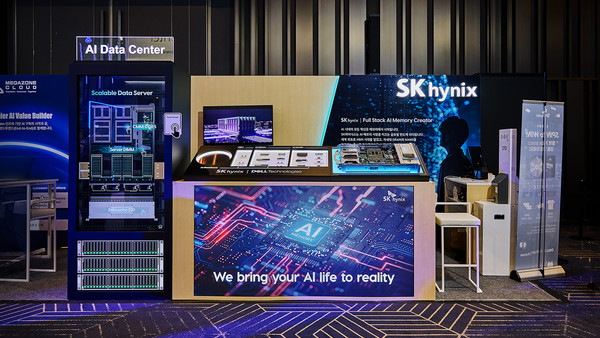
SK hynix used the Dell Technologies Forum 2026 in Seoul to unveil its next generation of AI-optimized memory, introducing HBM4 and HBM4E alongside a broad suite of server DRAM and SSD products designed for AI servers, data centers, and client PCs. The showcase, held on August 25 at COEX, signaled the company’s intent to compete across the full memory stack as AI workloads scale.
Hosted by Dell Technologies, the regional forum highlighted the firms’ ongoing partnership. SK hynix has taken part in the Seoul event since 2023 and underscored joint work again this year by displaying Dell’s R770 server paired with SK hynix–certified components, including 6400MT/s DDR5 RDIMM and the PS1010 E3.S SSD. The company previously participated in Dell Technologies World 2026 earlier this year.
HBM drew particular attention. SK hynix presented HBM3E alongside the new HBM4 and HBM4E lines. High Bandwidth Memory vertically stacks DRAM dies to deliver very high throughput and capacity, a configuration widely used in AI accelerators. For AI server main memory, the company exhibited a 192GB SOCAMM2 module aimed at power and space efficiency; SK hynix has announced a plan to manufacture a 192GB SOCAMM2 using 1cnm-class LPDDR5X. On the server DRAM side, products included 256GB 3DS RDIMM, 128GB MRDIMM, and 64GB RDIMM built on 10nm-class sixth-generation “1c” process technology. A second-generation CXL-based CMM-DDR5 was also shown to extend capacity and bandwidth between processors and memory.
Enterprise SSDs featured cooling and efficiency advances. SK hynix highlighted the PEB210 E1.S supporting direct liquid cooling, the high-capacity, low-power PS1110 E3.S, and the QLC-based PS1101 E3.S. The company also mapped its AI NAND and client SSD roadmap with models such as PEB210 E1.S and M.2, PCB01, PVF01, PQF02A/PQF02, and PQC21.
The booth replicated an AI server rack, with touchscreens guiding visitors through where components sit in real systems. Four zones—HBM, AI DRAM, AI NAND, and “AI Reality”—framed how memory pieces interact across training and inference pipelines rather than as stand-alone parts.
In a keynote titled “The Invisible Engine: Technology Completing the AI Era,” Vice President Ju Young-pyo emphasized memory as the “invisible engine” that determines AI performance from storage to system levels, noting SK hynix’s preparations for continued innovation as AI adoption grows. Breakout sessions detailed SSD strategies for AI data centers focused on enterprise SSD efficiency, and next-generation client SSDs for on-device AI such as AI PCs.
As generative AI increases compute intensity, competition in memory is broadening beyond HBM to include server DRAM, high-capacity SSDs, low-power modules, and new form factors. SK hynix indicated it will deepen collaborations with global technology partners, including Dell, while accelerating a full-stack AI memory strategy spanning HBM, DRAM, and NAND for servers and PCs.