
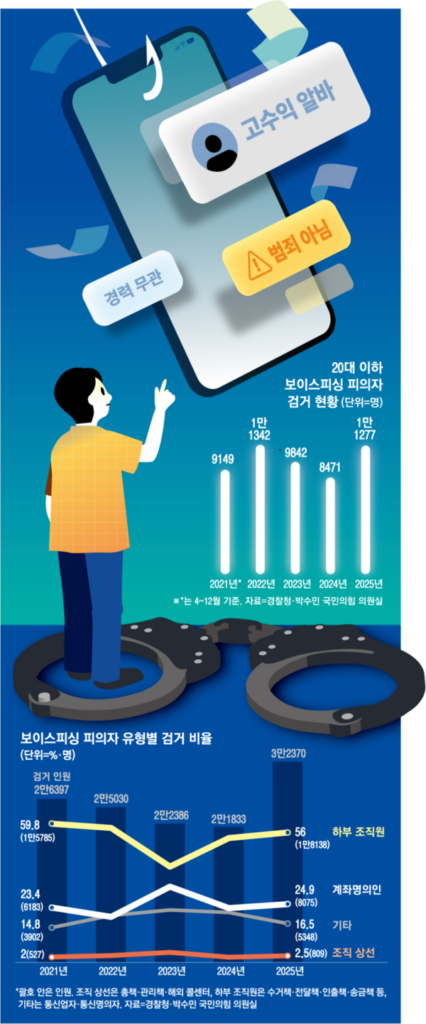
Voice phishing rings in South Korea—phone fraud schemes often built on impersonating officials or bank staff—are increasingly recruiting through deception: posing first as lenders or employers, they lead targets from innocuous errands to moving illicit funds. Police and courts report that ordinary loan seekers and job hunters are being drawn in, sometimes believing they are satisfying loan requirements or doing casual work.
Recruitment spreads via job boards, social networking services and messengers with pitches like “high‑paying part‑time,” “debt collection,” “loan money delivery” and “client payment collection.” Authorities note legitimate firms rarely entrust large cash handling to strangers without proper hiring. Newer tactics build “trust” by paying small fees for simple tasks—account transfers, document forwarding, mailing parcels—before escalating to repeated movements of large sums, including requests to buy cryptocurrency such as Bitcoin or Tether and send it to specified wallets. In some cases, people who already lost money are told a loan can be “restored” if they help collect cash, turning prior victims into conduits to new ones.
Ignorance is no blanket defense. In December 2024, South Korea’s Supreme Court directed judges to examine how contact occurred, whether a genuine employment contract existed, whether tasks resembled normal work, the amount and frequency of funds handled, how money was delivered, and whether pay was ordinary. Even without grasping the full scheme, liability can follow if the person recognized a possibility of voice phishing and proceeded.
Trial courts have enforced that line. In July, the Changwon District Court sentenced a man in his twenties to one year and six months in prison after he acted as a cash collector in a low‑interest refinance ruse and passed along 146.3 million won. In another case, a defendant who thought he joined “real‑estate work” was convicted after repeatedly receiving large checks; judges cited the absence of interviews or vetting and the irregular duties. By contrast, some cash handlers have been acquitted when their background, recruitment path and tasks made awareness unlikely; the core test is whether red flags existed and the person continued anyway.
Police continue on‑site arrests. In March 2026, officers detained a collector arriving to pick up a victim’s cash; he claimed he was “just a part‑timer.” Officials warn against lending bank accounts, phones or IDs, or delivering money as “harmless gig work.” The clearest red flag is the money flow: strangers routing funds through your account, demanding conversion to crypto, or directing cash drop‑offs signal imminent risk.